

AI for energy demand prediction to optimise District Heating Network (DHN) operation
A District Heating Network (DHN) is a heating system consisting of a thermal plant and a pipe network filled with hot water. The hot water is circulated by pumps, from the thermal plant to the consumer and back again to the thermal plant. Nowadays, DHN are operated without considering future demand. In this way, both heat production equipment and accessories are not working optimally.
If it is possible to adapt energy produced to the demand, minimising the margin between the energy that the consumer needs and energy generated, costs can be reduced. Thus, the energy consumption can be reduced by adapting the energy production to the real demand, decreasing the gap between the production and the consumption.
I-NERGY aims to develop a tool based on Artificial Intelligence (AI) that allows facility managers (FM) to predict the energy demand to optimise DHN. The objective of the Use Case 3 (UC3) is to optimise the operation of the DHN to decrease the energy consumption by matching the demand to the production, considering the future weather conditions. Thus, AI will be applied to obtain accurate demand predictions and to improve the network parameters with an optimal O&M, reducing the failures and increasing its efficiency. For UC3, two services will be developed, S10 and S11:
- S10 - Energy load/consumption/demand forecasting
- S11 - AI for energy demand prediction to optimise DHN operation
The main goal of UC3 is to decrease energy consumption by matching the demand to the production through energy demand predictions based on AI, optimising the DHN and reducing GHG emissions. In addition, the study of the demand will allow FM to better understand the installation. With this knowledge it is possible to decrease the number of failures and breakdown, to reduce O&M costs, and to improve facility analysis. An accurate forecast of demand leads to economic benefit. The cost will be reduced and the return of investment (ROI) will be improved.
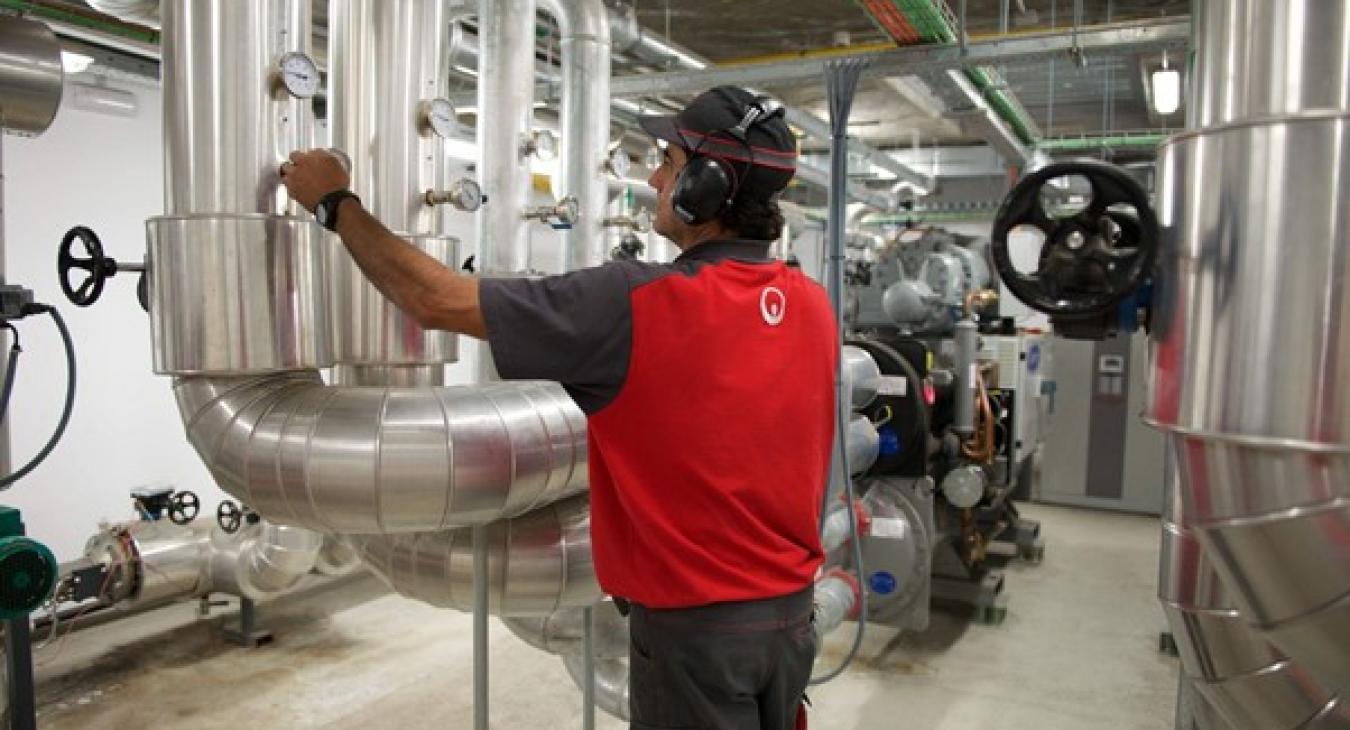
To develop the tool related to UC3, DHN monitoring data of Hospital Universitario Reina Sofía (HURS) in Cordoba (Spain) is used. This health complex consists of a multi energy system that provides steam, heating, cooling and Domestic Hot Water (DHW) to the different buildings of the hospital. There are a total of 12 substations. The thermal plant of the hospital has 4 heating boilers, 2 steam boilers, 6 chillers and 2 fan coolers. This plant can produce 9MW of heating power, 4 MW of steam power and 11.5 MW of cooling power. Besides the equipment installed in the thermal plant: to produce heat, in 2 substations there are heat pumps and solar thermal; to generate cool, in 2 substations there is an individual chiller; and to supply electricity, there is a PV plant for self-consumption with a power of 1.7 MWp. There are a total 131 variables available to monitor the facility. These variables allow I-NERGY to develop the tool that predicts the demand.
Veolia in this pilot covers the role of the district heating FM, aiming at generating AI analytics to improve FM processes.
In order to determine if the pilot achieves the goals, the following users stories of UC3 are considered:
- Energy consumption and GHG emissions reduction.
- Failure rates in facilities decrease.
- Profit increase.
- Easier development of new DHN.
To quantify the users stories, the following Key Performance Indicators (KPIs) are defined:
| KPI | Definition |
|---|---|
| Energy savings (natural gas) | Difference between measured and reference Natural Gas consumption data, evaluated within a predefined period of time. |
| Energy savings (electricity) | Difference between measured and reference Electricity consumption data, evaluated within a predefined period of time. |
| GHG emissions reduction | Difference between measured and reference GHG emissions data, evaluated within a predefined period of time. |
| Demand forecasting accuracy | Calculate the forecast accuracy using the Mean Absolute Percentage Error (MAPE) between actual and forecasted demand. |